
Inside the current PsyReview workspace
We processed this packet in the authenticated PsyReview application on October 31, 2026. All eight pages completed processing, and the chronology displayed 37 evidence entries. The screenshot below is an actual application capture using only the fictional records, not a designed product mockup.
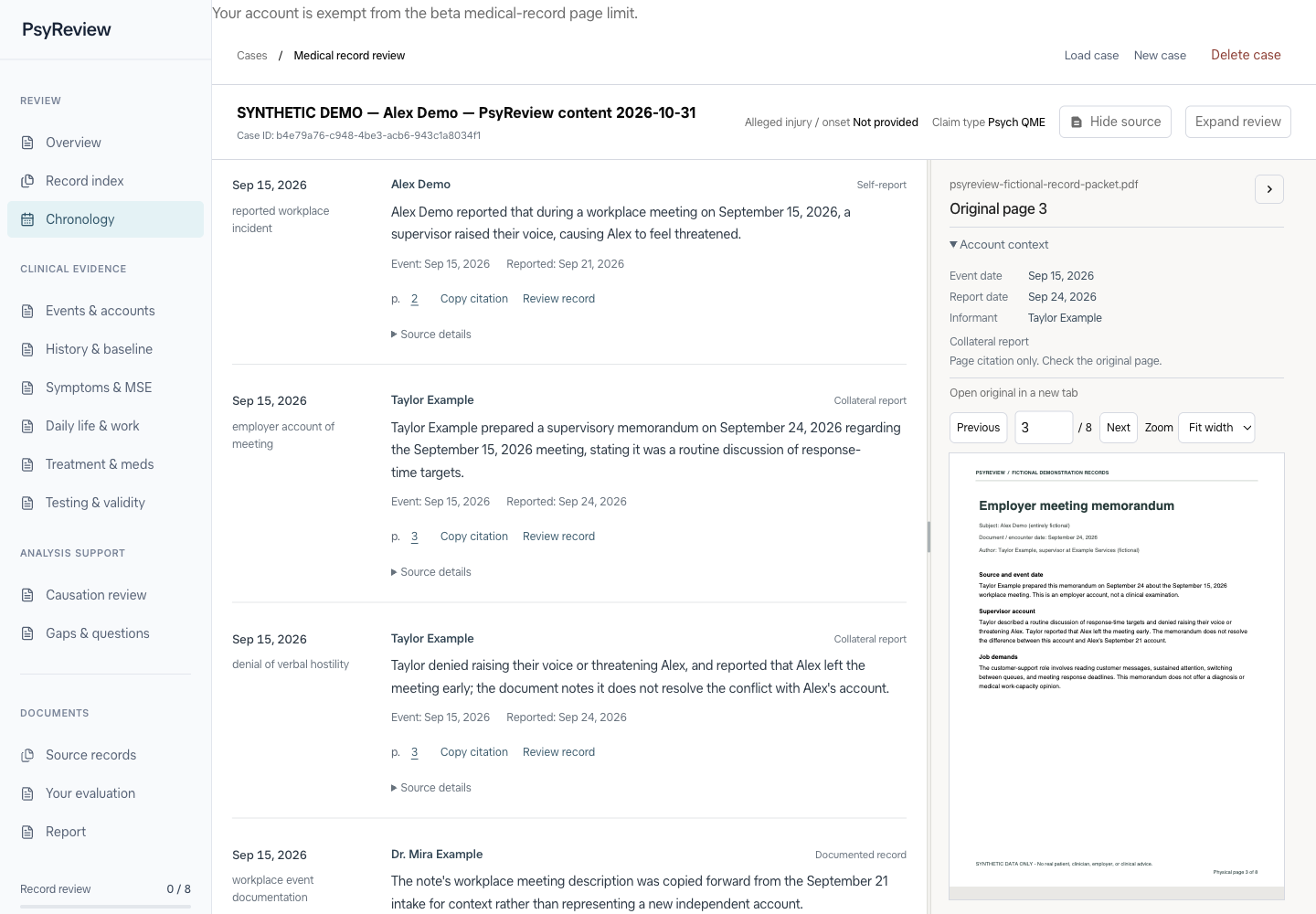
The meeting is dated September 15. The two accounts were recorded September 21 and September 24. The open source panel identifies the employer account, its dates, and the original PDF page. Open the full-size screenshot.
The application retained the differing meeting accounts and identified the later note’s copied-forward history. Its citations in this run opened original pages; they were page-level references, not verified highlighted excerpts. These observations describe this demonstration only, not an accuracy benchmark.
What is in the packet
Keep the event and its later accounts distinct
The workplace meeting is dated September 15. Alex describes it at the September 21 intake on page 2. The supervisor writes a different account on September 24, on page 3.
An editorial review note could read:
Alex reported that the supervisor raised their voice during the September 15 meeting (p. 2, account recorded September 21). The supervisor denied raising their voice (p. 3, memorandum dated September 24). The supplied records do not resolve the difference.
This paragraph is an editorial illustration, not a verbatim software export. Its purpose is to show the attribution that a reviewer should preserve. The account dates do not replace the date of the meeting, and neither account becomes an established finding merely because it appears in a summary.
Carry medication details with their qualification
On page 4, Alex reports starting sertraline 25 mg daily on September 22 and experiencing mild nausea. The September 29 note states that the outside prescribing note was not supplied.
The review should retain all four elements: the medication, the dose, the reported timing, and the missing prescribing record. Describing this simply as “sertraline prescribed September 22” would lose the distinction between a patient account and a directly reviewed prescription.
Compare work-function accounts without deciding credibility
Page 5 records Alex’s statement that every scheduled shift from September 28 through October 2 was attended. Page 6 reports absences on September 30 and October 2. The underlying time-clock entries and schedule amendments are absent.
A useful follow-up question is: Do the underlying attendance records or any schedule changes explain the difference? The packet does not answer that question. It also does not establish why either shift was missed.
The earlier temporary reduced-schedule recommendation on page 2 is a separate piece of information. Do not silently extend it into a later work-capacity opinion that no supplied clinician recorded.
Preserve improvement and continuing difficulty together
The later notes describe longer reported sleep while concentration difficulties continue. A review that says only “improved” would flatten the course; one that says only “persistent symptoms” would omit the reported change.
Track the particular symptom or activity and its date. The October 20 note also records that no updated work-capacity determination was documented. That limitation should remain visible alongside the functional history.
Treat missing information as a review task
The packet deliberately leaves several items unavailable:
- The earlier counseling records mentioned in the history.
- The outside prescribing note.
- The underlying attendance entries and schedule amendments.
- The completed screening response sheet.
The screening note reports a PHQ-9 total score of 8, but no performance-validity or symptom-validity testing is documented. That absence does not establish a validity finding or a malingering determination.
Use this packet to assess a record-review workflow
Open the original PDF beside each generated statement. Check the source page, attribution, date, and qualifiers. Then ask whether the software makes the next review task easier to identify.
Our source check also found wording that needed correction. On page 7, the source says no validity testing was documented. An extracted entry changed that to no testing was conducted. Those statements are not equivalent: an incomplete packet cannot establish that testing never occurred. Another entry strengthened the earlier history from “improved with counseling” to “resolved with counseling.” The stronger wording was not supported by page 1.
We leave those limitations explicit rather than treating the generated entries as approved clinical prose. The source-linked workflow is useful because it gives the reviewer a route back to the underlying evidence; the reviewer still needs to check and correct the wording before using it.
This small, text-based packet is intentionally easy to inspect. It does not measure accuracy on scanned records, large files, handwriting, or real-world case complexity. A demonstration should make its limits as visible as its successful outputs.
For a broader preparation process, read Preparing records for a psychological QME or AME evaluation. For product selection, see the seven-tool buying guide.
Discuss a record-review demonstration. Please keep patient-identifying information out of the initial inquiry.